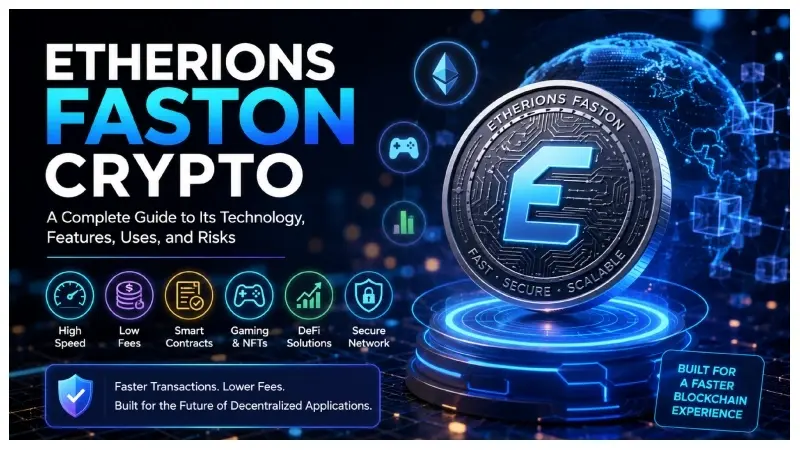
Etherions Faston Crypto is a topic that interests people researching blockchain technology, digital assets, smart contracts, decentralized applications, and faster transaction systems.
Blockchain projects often compete on speed, fees, scalability, security, and developer usability. However, attractive claims do not automatically prove that a network delivers reliable performance.
That is why researching an unfamiliar crypto project requires more than reading promotional descriptions. Users should examine technical documentation, token information, development activity, security records, network data, and independent evidence before interacting with any digital asset.
This guide explains what readers should know about Etherions Faston Crypto, its potential technology, possible applications, benefits, limitations, and risks.
What Is Etherions Faston Crypto?
Etherions Faston Crypto is a term associated with a blockchain-focused project and its potential digital-asset ecosystem.
The topic is generally connected with ideas such as faster transactions, lower network costs, smart contracts, Ethereum-compatible applications, gaming, NFTs, and decentralized finance.
These are important areas within the broader blockchain industry. Developers continue to search for networks that can process transactions efficiently while maintaining security and decentralization.
However, readers should separate project claims from independently verified information.
A blockchain may advertise high speed or low fees. Yet real-world performance can vary based on network activity, transaction complexity, infrastructure, and technical design.
Therefore, anyone researching this project should verify its current specifications through reliable primary sources before making financial or technical decisions.
Why Blockchain Speed Matters
Transaction speed plays an important role in blockchain usability.
A network that takes too long to confirm transactions can create frustration. High fees can create another barrier, especially for applications involving frequent small transactions.
Consider a blockchain game. Players may need to transfer assets, claim rewards, or trade digital items several times during a session.
If each transaction becomes expensive or slow, the experience can suffer.
The same issue affects decentralized finance. Users may interact with smart contracts for swaps, lending, liquidity, staking, and other activities.
For this reason, faster blockchain infrastructure can be useful.
However, speed should never be considered separately from security.
A network that processes transactions quickly but lacks adequate security may create greater risks for users.
How to Evaluate Etherions Faston Crypto
The best way to research an unfamiliar crypto project is to examine several areas instead of focusing on one advertised feature.
Technical Documentation
Start with technical documentation.
Look for explanations of:
- Network architecture
- Consensus mechanism
- Transaction processing
- Smart contracts
- Validators
- Token utility
- Network fees
- Security practices
- Interoperability
- Development plans
Clear documentation makes it easier to understand what the project actually offers.
If important technical information remains unclear, users should avoid making assumptions.
Blockchain Activity
If the project operates on a publicly accessible blockchain, network activity can provide useful evidence.
Researchers can examine transaction activity, wallet interactions, contract usage, and other available on-chain information.
This can help determine whether claimed activity matches observable network behavior.
Development Activity
Development activity is another useful indicator.
Public repositories, technical updates, release notes, and developer discussions can show whether a project continues to receive attention.
A strong project should ideally provide meaningful updates rather than relying entirely on promotional statements.
Ethereum Compatibility and EVM Technology
Ethereum has one of the largest smart-contract ecosystems in the blockchain industry.
Its development environment supports tools, wallets, programming languages, and frameworks used by thousands of developers.
That makes Ethereum Virtual Machine compatibility potentially valuable for newer blockchain projects.
If Etherions Faston supports EVM-compatible development, developers may be able to work with familiar technologies.
This could reduce the learning curve for teams already familiar with Ethereum-based applications.
However, compatibility should always be verified.
EVM compatibility does not automatically mean every Ethereum application can move to another network without testing.
Developers should review the project’s official technical documentation before deploying smart contracts.
Transaction Speed and Network Efficiency
Transaction performance is one of the most important factors when evaluating blockchain infrastructure.
However, a single speed claim does not provide a complete picture.
Researchers should consider several measurements:
- Transaction confirmation time
- Finality time
- Throughput
- Average transaction fees
- Network congestion
- Validator distribution
- Historical uptime
- Failed transaction rates
These measurements provide a more realistic picture of network performance.
For example, a network may appear extremely fast under low activity but behave differently when demand increases.
Therefore, actual network data is more useful than an isolated marketing number.
Smart Contracts and Decentralized Applications
Smart contracts allow developers to create applications that execute predetermined rules on a blockchain.
They support many blockchain use cases, including:
- Decentralized exchanges
- NFT marketplaces
- Lending applications
- Gaming platforms
- Staking systems
- Token launches
- Governance platforms
- Digital collectibles
If Etherions Faston provides a compatible smart-contract environment, developers could potentially use such technologies within its ecosystem.
Still, smart contracts introduce security risks.
A programming error can potentially result in financial losses. Even audited contracts are not guaranteed to be completely secure.
For that reason, developers should review contract code, audit reports, documentation, and deployment history before interacting with applications.
Etherions Faston Crypto and Gaming
Blockchain gaming is one potential use case for fast and affordable transaction infrastructure.
Traditional games usually store ownership information inside centralized databases.
Blockchain games can use tokens and NFTs to represent certain digital assets.
Depending on the game’s design, these assets can include:
- Characters
- Weapons
- Collectibles
- In-game items
- Rewards
- Memberships
- Marketplace assets
A blockchain with efficient transactions may make frequent digital-asset transfers more practical.
However, blockchain technology does not guarantee that a game will succeed.
A successful gaming ecosystem also needs strong gameplay, sustainable economics, security, active users, and a reliable development team.
NFTs and Digital Collectibles
Non-fungible tokens have become another major blockchain application.
NFTs can represent digital collectibles, artwork, memberships, tickets, gaming items, and other forms of blockchain-based ownership.
Transaction fees can influence the economics of NFT platforms.
When fees are high, creators may find it difficult to mint affordable collections.
Lower transaction costs can make experimentation more accessible.
However, NFT buyers should understand what ownership actually provides.
Owning an NFT does not automatically mean owning copyright or commercial rights to the underlying artwork.
Users should read the project’s terms and verify the rights attached to each asset.
DeFi and Financial Applications
Decentralized finance uses blockchain-based smart contracts to provide financial services without relying entirely on traditional intermediaries.
Common DeFi applications include:
- Decentralized exchanges
- Token swaps
- Lending platforms
- Liquidity pools
- Staking
- Yield strategies
- On-chain financial tools
Fast transactions can improve the user experience in these applications.
However, DeFi carries substantial risks.
Smart contract vulnerabilities can cause losses. Liquidity problems can also affect users.
Other risks include:
- Token volatility
- Oracle failures
- Bridge vulnerabilities
- Economic exploits
- Low liquidity
- Poorly designed tokenomics
Therefore, low transaction fees should never be the only reason to use a DeFi platform.
Cross-Chain Interoperability
Blockchain ecosystems often operate independently.
Users may therefore need systems that move assets or information between different networks.
Cross-chain bridges attempt to provide this functionality.
If Etherions Faston offers interoperability features, users should carefully examine how those systems work.
Bridge technology can introduce additional security risks because assets may move through complex smart contracts and verification mechanisms.
Before transferring funds, users should verify:
- Official contract addresses
- Supported networks
- Bridge documentation
- Security audits
- Transaction limits
- Security history
- Recovery procedures
Never copy a contract address from an unknown social media account or random website.
Security Considerations
Security should be one of the first things users investigate.
A visually impressive website does not prove that a blockchain project is secure.
Instead, look for evidence.
Transparent Documentation
Technical documentation should explain how the system works.
Important information includes the network design, validator model, token economics, transaction system, and smart-contract environment.
Independent Audits
Audits can help identify vulnerabilities in smart contracts and blockchain-related applications.
However, an audit does not guarantee that a project is risk-free.
Users should examine the complete audit report rather than relying on an “audited” label.
Open Development
Public development activity can provide additional insight.
Regular updates, code changes, technical discussions, and issue tracking may help users understand whether development remains active.
Team Transparency
Information about developers and project leadership can also help users assess accountability.
An anonymous team does not automatically prove that a project is fraudulent.
However, limited transparency means users may need stronger independent evidence before trusting the project.
Is Etherions Faston Crypto Legit?
The legitimacy of a crypto project should not be judged by its name, website appearance, social media followers, or promotional articles.
Instead, investigate the available evidence.
Before interacting with the project, look for:
- Official documentation
- Verified contract information
- Token supply details
- Token distribution
- Development activity
- Security audits
- Blockchain explorer data
- Exchange information
- Community activity
- Team information
- Clear project documentation
If important information cannot be independently confirmed, proceed carefully.
A lack of available evidence does not automatically prove that a project is fraudulent.
It does mean that users have fewer reliable facts on which to base decisions.
Etherions Faston Crypto: Claims vs. Evidence
This distinction is especially important when researching cryptocurrency.
A project may claim that its network is faster, cheaper, safer, or more scalable than competing platforms.
Those statements should be tested against evidence.
Instead of asking only:
How fast is the network?
Ask:
Where does the performance data come from?
Instead of asking:
Are transaction fees extremely low?
Ask:
What do actual transactions show under different network conditions?
Instead of asking:
Is the project secure?
Ask:
Are there independent security audits and publicly available technical reports?
This approach protects readers from relying entirely on marketing claims.
Potential Benefits
If the project’s stated infrastructure and capabilities are independently verified, several potential benefits could make it interesting.
Faster Transactions
Efficient transaction processing can improve user experience.
Lower Costs
Lower fees can make frequent transactions more practical.
Developer Compatibility
EVM compatibility can potentially reduce migration challenges for Ethereum developers.
Gaming Applications
Affordable transactions can support blockchain gaming and digital-asset marketplaces.
NFT Applications
Efficient infrastructure may make NFT minting and trading more accessible.
DeFi Use Cases
Lower transaction costs can support more frequent smart-contract interactions.
These are potential benefits rather than guarantees.
The actual value depends on technical performance, adoption, security, liquidity, and continued development.
Risks of Etherions Faston Crypto
Cryptocurrency carries significant risk.
Anyone researching this project should consider several important factors.
Market Volatility
Digital assets can experience substantial price movements.
Market sentiment, liquidity, news, regulation, and broader economic conditions can all affect token prices.
Smart Contract Risk
A vulnerability in a smart contract can potentially cause financial losses.
Audits can reduce certain risks but cannot eliminate every possible weakness.
Liquidity Risk
Low trading volume can make an asset difficult to buy or sell efficiently.
Users should therefore examine available liquidity before committing funds.
Regulatory Risk
Crypto regulations continue to evolve across different countries.
Changes in laws can affect exchanges, tokens, taxation, and access to blockchain services.
Bridge Risk
Cross-chain systems can create additional technical vulnerabilities.
Users should treat bridge transfers carefully and verify official infrastructure before moving assets.
Information Risk
One of the biggest risks with unfamiliar projects is incomplete information.
If users cannot verify basic technical or token details, they should avoid making assumptions.
How to Research the Project Before Using It
Good research can prevent avoidable mistakes.
Start with official documentation.
Next, verify contract information independently.
Then examine available blockchain activity.
After that, review security information and audit reports.
Finally, compare the project’s claims with observable evidence.
A practical research checklist looks like this:
- Find the official project source.
- Read the technical documentation.
- Verify the token and contract information.
- Check blockchain activity.
- Review security audits.
- Investigate development activity.
- Examine liquidity and market availability.
- Research the team and project history.
- Look for clear risk disclosures.
- Never invest based on promotional content alone.
This process is more reliable than trusting a single article or social media post.
Etherions Faston Crypto vs. Established Blockchains
Comparing a newer blockchain project with established networks requires more than comparing transaction speed.
Ethereum has a large developer ecosystem and extensive infrastructure.
Bitcoin has a different primary role focused on decentralized digital money and network security.
Other blockchain platforms emphasize different combinations of speed, fees, scalability, and application support.
A useful comparison should examine:
| Factor | What to Evaluate |
|---|---|
| Speed | Confirmation and finality data |
| Fees | Actual transaction costs |
| Security | Audits and network history |
| Adoption | Users and active applications |
| Ecosystem | Developers and integrations |
| Liquidity | Trading activity and markets |
| Transparency | Documentation and public information |
| Development | Updates and technical activity |
This approach creates a more meaningful comparison than relying on headline performance numbers.
What Could Affect Future Growth?
Several factors could influence the future of any blockchain project.
Developer Adoption
Developers create applications that can attract users and generate network activity.
Real-World Usage
A network needs meaningful use cases rather than attention alone.
Security
Security becomes increasingly important as more assets move through a network.
Liquidity
Users generally need accessible markets to buy, sell, and use digital assets.
Transparency
Clear documentation and verifiable information can increase confidence.
Community
An active community can support development, testing, education, and adoption.
Ultimately, long-term growth depends on real usage rather than promotional attention.
Frequently Asked Questions
What is Etherions Faston Crypto?
Etherions Faston Crypto is a blockchain-related topic associated with digital assets, transaction efficiency, smart contracts, and potential Ethereum-compatible applications. Readers should verify current project information through reliable primary sources.
Is Etherions Faston Crypto the same as Ethereum?
No. Ethereum is an established blockchain ecosystem. Etherions Faston should be evaluated independently, even if it claims compatibility with Ethereum-related technologies.
Does Etherions Faston Crypto support smart contracts?
The project is discussed in connection with smart-contract functionality. However, users should verify the current technical capabilities through official documentation before deploying or interacting with contracts.
Can it be used for gaming?
Blockchain infrastructure can support gaming applications involving tokens, NFTs, rewards, and digital marketplaces. Whether specific gaming applications exist should be independently confirmed.
Is Etherions Faston Crypto safe?
No cryptocurrency or blockchain platform should automatically be considered completely safe. Users should examine security audits, contracts, development activity, liquidity, and network history before interacting with an unfamiliar project.
Should I buy Etherions Faston Crypto?
There is no universal answer. Buying any crypto asset involves financial risk. Users should conduct independent research and consider their own financial circumstances and risk tolerance.
Why are blockchain transaction fees important?
Transaction fees affect how practical a network is for frequent activity. Lower fees can make smaller transactions more economical, but fees should always be considered alongside security, reliability, and network adoption.
What should I check before using a new crypto project?
Check official documentation, contract addresses, token information, network activity, security audits, development history, liquidity, team information, and independent evidence.
Final Verdict
Etherions Faston Crypto is a topic worth researching within the broader discussion around blockchain scalability, digital assets, smart contracts, gaming, NFTs, and decentralized finance.
However, readers should avoid judging a crypto project only by advertised speed, low fees, or promotional claims.
Technology matters.
Security matters.
Developer adoption matters.
Liquidity matters.
Transparency matters too.
The strongest approach is to verify information before trusting it.
Check official documentation. Review network data. Examine security reports. Verify contract information. Research development activity. Compare claims with independent evidence.
Most importantly, remember that potential technology does not automatically equal financial value.
A blockchain can have interesting features and still face adoption, security, regulatory, or market challenges.
For that reason, research should always come before investment.
If you approach Etherions Faston Crypto with a verification-first mindset, you can better understand its potential while also recognizing the risks that come with unfamiliar blockchain projects.